Posts

Statas MCQs 15

1. In inferential statistics, we study A) the methods to make decisions about population based onsample results ✔ B) how to make decisions about mean, median or mode C) how a sample is obtained from a population D) None of the above 2.In descriptive statistics, we study A) The description of decision making process B) The methods for organizing, displaying, and describing data✔ C) How to describe the probability distribution D) None of the above 3.When data are collected in a statistical study for only a portion or subset of all elements of interest we are using: A) A sample ✔ B) A Parameter C) A Population D) Both b and c 4.In statistics, a sample means A) A portion of the sample B) A portion of the population ✔ C) all the items under investigation D) none of the above 5.The height of a student is 60 inches. This is an example of A) Qualitative data B) Categorical data C) Continuous data ✔ D) Discrete data 6.Data in the Population Census Repor...

General MCQs

1. In view of Friedman's money quantity theory ,which one option  is not matched against Money means : 1.Money 2.Bonds 3.Equity 4.all✔ 2.Non Accelerating Inflation Rate of Unemployment (NAIRU) means :- (1) A rate of unemployment for which the change in the rate of inflation is zero.✔ (2) A rate of inflation which makes the rate of unemployment zero. (3) A rate of inflation for which the change in the rate of unemployment is zero. (4) A rate of unemployment which is equal to the rate of inflation.  3.For the capitalist economy, the primary objective of the New Classical Economics is to explain which of the following ? (1) Business cycle phenomenon (2) Underemployment (3) Wage – price rigidity (4) Effectiveness of Government policy 4. Natural Unemployment is a part of ..... 1.Fresheshr Job seekers 2.Exprinced Job seekers but his/her choice  3.Normal Job seekers in any field   4. 1 or 2 ✔ 5. In which situation money multiplier will be more ...

MCQs 50

1.Law of demand which describe the  relation  bw Price and ...... a.Demand change b.Quantity Demand change c.Quantity Demand✔ d.1&2 2.What is income elasticity for inferior goods ? a.Ey>1 b.Ey<1✔ c.Ey= d.1or 2 3.What is income elasticity for Necessary goods ? a.Ey>1 b.Ey<1✔ c.Ey= d.1or 2 5.What is income elasticity for luxury  goods ? a.Ey>1✔ b.Ey<1 c.Ey= d. 1or 2 6.Chamberlin has introduced ______________ models of equilibrium in monopolistic competition. a. one b. two c. three✔ d.four 7. Chamberlin has introduced a second demand curve named as _________________. a. Individual demand curve b. planned sales surve c. actual sales curve✔ d. All of the above 8.The actual sales curve or second demand curve is derived by the locus of points of shifting ________________ as competitors change their prices. a. individual demand curve✔ b. Marginal cost c. Both a & b d. None of the above 9.the indi...

DISTRICT INDUSTRY CENTRE (DIC)

DISTRICT INDUSTRY CENTRE (DIC) programme was started by the central government in 1978 with the objective of providing a focal point for promoting small, tiny, cottage and village industries in a particular area and to make available to them all necessary services and facilities at one place. The finances for setting up DICs in a state are contributed equally by the particular state government and the central government. To facilitate the process of small enterprise development, DICs have been entrusted with most of the administrative and financial powers.  Activities of District Industries Centre :- i. Economic Investigation ii. Plant and Machinery iii. Research, education and training iv. Raw materials v. Credit facilities vi. Marketing assistance vii. Cottage industries Objectives of District Industries Centre:- i. Accelerate the overall efforts for industrialisation of the district. ii. Rural industrialisation and development of rural industries and ...

Finanacial Committee & Commission

Image
                       1. नरसिम्हन समिति (1991): बैंकिंग क्षेत्र सुधार 2.पारेख समिति: इन्फ्रास्ट्रक्चर फाइनेंसिंग 3. पर्सी मिस्त्री समिति: मुंबई को अंतर्राष्ट्रीय वित्तीय केंद्र बनाना 4. पी. जे. नायक समिति: बैंकों के बोर्ड के शासन का मूल्यांकन करने और निदेशकों, साथ ही साथ उनके कार्यकाल का चयन करने के लिए मानदंडों की जांच करना 5. प्रसाद पैनल: अंतर्राष्ट्रीय व्यापार और सेवाएँ 6. आर. वी. गुप्ता समिति: लघु बचत 7. राजा चेल्या समिति: कर सुधार 8. रेखी समिति: अप्रत्यक्ष कर 9. आर.वी. गुप्ता समिति: कृषि ऋण 10. एस. पी. तलवार समिति: कमजोर सार्वजनिक क्षेत्र के बैंक का पुनर्गठन 11. सुरेश तेंदुलकर समिति: गरीबी रेखा को पुनर्परिभाषित करना और उसकी गणना सूत्र 12. सप्त ऋषि समिति (जुलाई 2002): घरेलू चाय उद्योग का विकास 13. शाह समिति: गैर बैंकिंग वित्तीय कंपनियों (NFBCs) से संबंधित सुधार 14. शिवरामन समिति (1979): नाबार्ड की स्थापना 15. एस.एन. वर्मा समिति (1999): वाणिज्यिक बैंकों का पुनर्गठन 16. स्वामीनाथन आयोग (2004): किसानों के ...

CUCET PhD Entrance MCQs

1.Which of the following is the better role of Neo classical welfare economist ?                     A.Pigue>Marshal >Cannon    B.Marshal>Cannon>  Pigue    C.Marshal>Pigue> Cannon✔         D.Marshal >Cannon >Redar 2. Which is not correct in Neo-Classical welfare Economics ?    A.Consumer Surplus          B.National Income          C.Distribution Of income      D.Cause and Effect✔ 3.For the production function  Q=A.L^a.K^b the marginal rate of substitution of capital For labour is given by :-                  A.a/L . L/b                         B.a/b . K/L  ✔                     C.b/a .L/K    ...

FRBM Act 2003 & Finance Commission

Image
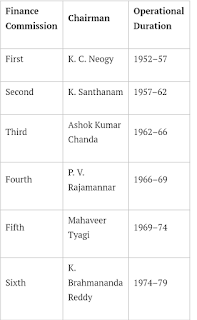
Fiscal Responsibility Budget  1.Fiscal responsibility budget management act was enacted in 2003. 2.Its establishment was recommended by yaswant sinha commite. 3.Its objective is to reduce fiscal deficit and eliminate primery deficit by 2008-2009. 4.Bring down the fiscal deficit to 3% by 2008. 5.Objective is to move towards balance budget multiplier. 6.Targets of FRBM ACT A.Revenue deficit:-  Date of elimination - 31 march 2009  Postponed from 2008 Minimum annual reduction - 0.5 % of GDP B. Fiscal deficit:- Ceiling - 3% of GDP by march 2008  Minimum annual reduction - 0.3 % of GDP C.Total Debt -  9% of GDP  Target increased from original 6 % requirement in 2004 2005  Annual reduction - 1% of GDP In 2016 N.K.Singh took the review of FRBM ACT and their targets are following:- a.Toreduce fiscal deficit  * 3% down to 2020 * 2.8% down to 2020 - 2021 * 2.5 % of GDP by 2023 High GST mopup may take goverment clos...